5th International Polar Year
RESEARCH
What is being proposed?
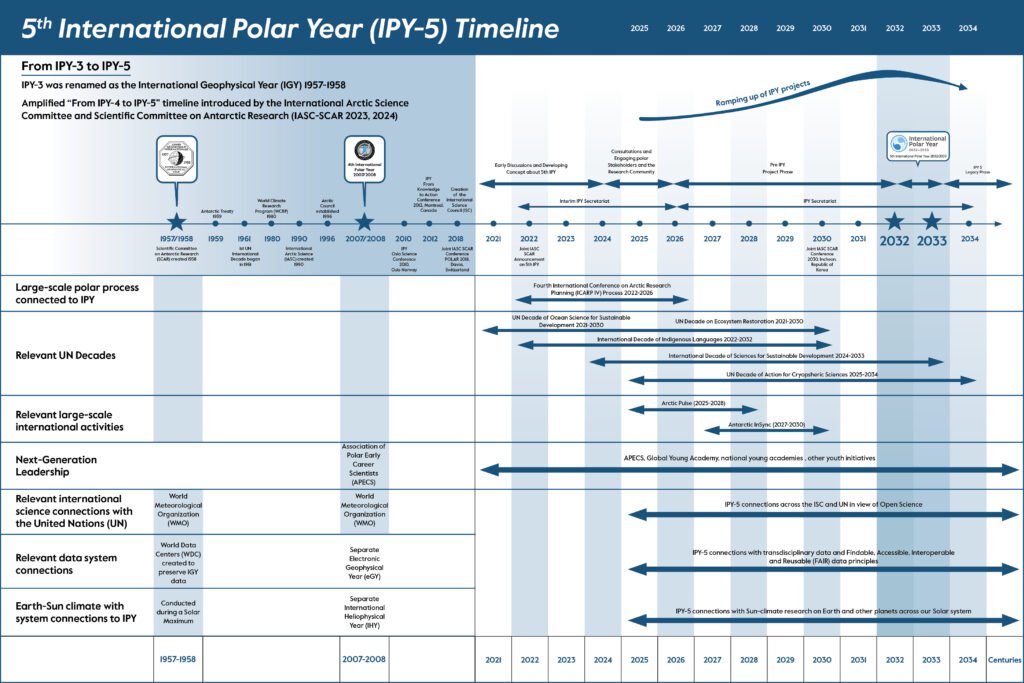
The 5th International Polar Year (IPY-5) 2032-2033 Initiative is being designed to amplify global lessons with science diplomacy that originated with the International Geophysical Year (IGY) 1957-1958, which was renamed from the 3rd International Polar Year (IPY-3). This IPY-5 Initiative builds directly on the Antarctic Treaty Summit in 2009 with HSH Prince Albert II of Monaco as the Patron and HE Ban Ki-moon among the keynotes – which was a project of the 4th International Polar Year (IPY-4) 2007-2008 – celebrating the 1959 Antarctic Treaty, which became the first nuclear arms agreement, emerging explicitly because of the IGY “with the interests of science and the progress of all mankind”. The Antarctic Treaty Summit generated the first book on Science Diplomacy. Amplification with this SDCI initiative is “From IPY-3 to IPY-5” (elaborated in an Invited Perspective in Cambridge Prisms that is in press), extending current international planning “From IPY-4 to IPY-5”, as introduced in 2023 and 2024 by International Science Council (ISC) committees. Following acceptance of the Cambridge Prisms paper, Professor Berkman has been invited onto “The International Polar Year 2032-33” panel at the ISC General Assembly in Oman in January 2025 to “share perspectives on how IPY-5 can serve as a model for producing inclusive, actionable, and co-produced knowledge with significant global implications.” IPY-5 is a rare research opportunity for humanity, when heightened funding nationally and internationally is anticipated with inclusion (who, what, when, where, why and how), as this IPY-5 Initiative is introducing with its transdisciplinary integration. Planning for IPY-5 is far enough into the future to be imaginative and hopeful, but close enough to be practical across our globally-interconnected civilization. IPY-5 also will be an important journey for next-generation science diplomats to shine, noting the: (a) GIYSCC Initiative; and (b) Thematic Network on Science Diplomacy with its Next-Generation Science Diplomat Committee (NGSDC) through the University of the Arctic (UArctic). Additionally, IPY-5 introduces a pedagogical playground to frame questions that contribute to sustainable development at local-to-global levels, considering the interplay with other International Years and International Decades (which began in 1961 after the IGY), perhaps even stimulating the first International Century. IPY-5 provides a shining star to enhance international scientific cooperation with common-interest building, especially in the Arctic, across the International Decade of Sciences for Sustainable Development (IDSSD) 2024-2033.
Who is involved?
The IPY-5 initiative is new and will be coordinated by Professor Berkman, seeking input from the Board to plan with global inclusion. Initially, the work will be accomplished with the: (1) NGSDC team; and (2) colleagues associated with the Arena for the gap analysis of the existing Arctic Science Co-Operations (AASCO) project (noting Professor Berkman will be co-convener of a meeting in Monaco in February 2025); and (4) Other ISC Fellows and ISC affiliation (who will be meeting in Oman in January 2025). Progressively, the IPY-5 Initiative will engage (4) diverse networks of collaborators involved with the Arctic Options/Pan-Arctic Options projects from 2014-2022.
How will this initiative be executed?
A funding strategy with the IPY-5 Initiative will build on the Antarctic Treaty Summit during IPY-4 as a case-study, which involved more the $750K for a three-day dialogue at the Smithsonian Institution from among more than forty partner organizations, including the Prince Albert II of Monaco Foundation in Monaco and the United States, Tinker Foundation, World Wildlife Fund, National Science Foundation, Marine Mammal Commission, Eisenhower Institute, and Raytheon. This project will require planning across IDSSD 2024-2033. Professor Berkman’s Oman trip currently is unfunded for his IPY-5 panel presentation. Initial funds also are being pursued with the NGSDC team and UArctic support through a $15K proposal – International Polar Year (IPY) Amplification “From IPY-3 to IPY-5” – to the International Arctic Science Committee (IASC) that will be submitted by 6 January 2025. If awarded by IASC and if approved by the SDCI Board, IASC funding would be administrated by SDCI rather than UArctic.
Why is this consistent with our mission? Where is impact driven?
The IPY-5 Initiative supports the SDCI mission with core continuity across the past four decades. This initiative will build a web and social media presence through which SDCI can shape global public perceptions of science diplomacy. This initiative will help to integrate transdisciplinary thinking and science diplomacy into Earth systems science with inclusion across the natural sciences, social sciences and Indigenous knowledge.
IPY-5 Projects
Antarctica Day
Celebrating "peace for all mankind"
Publications