Non-Resident Fellowship
The Science Diplomacy Center, Inc. (SDCI) Non-Resident Fellowship program brings together passionate next-generation science diplomats to create synergies for sustainable development across subnational, national, and international jurisdictions. Our Non-Resident Fellows contribute their expertise, working on cutting-edge initiatives spanning polar governance, climate science, international cooperation, and the integration of science into policy.
To apply for the Non-Resident Fellowship, connect with an SDCI director to sponsor your application, then complete and submit the application form to pab@scidiplo.org.
Non-Resident Fellows
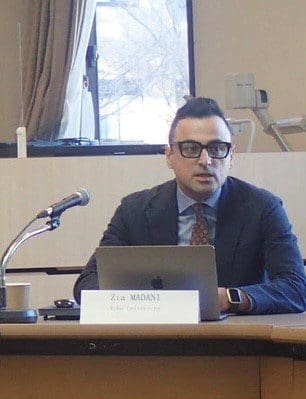
Dr. Zia Madani
ABOUT
As a researcher, educator, and practitioner, Dr. Zia Madani specializes in innovative approaches and methodologies in international law, particularly where cross-sectoral and multi-scalar systems perspectives are essential. His research focuses on the law-science-policy nexus, aiming to bridge the gap between scientific advancements and the formulation and implementation of science-based, evidence-informed laws and policies that address complex planetary challenges and their ramifications across diverse temporal, spatial, and systemic scales. As such, Dr. Madani is methodologically interested in qualitative research that crosses different disciplines and challenges conventional research paradigms and in transdisciplinary work with policy-makers and other stakeholder groups. He serves as a peer reviewer for Nature journals, and his research has been cited multiple times in Nature Communications and Nature Ecology & Evolution. With a PhD in Public International Law, Dr. Madani currently serves as an Assistant Professor of International Law at the University of Tsukuba, Japan, where he teaches courses of international environmental law, polar law, international humanitarian law, and the law of the sea. Previously, he held a Japan Society for the Promotion of Science (JSPS) postdoctoral research fellowship at Kobe University, and a Crown-Indigenous Relations and Northern Affairs Canada (CIRNAC)-funded research fellowship at the University of Saskatchewan. He also serves as Vice-Lead of the University of the Arctic (UArctic) Thematic Network on Science Diplomacy.
INITIATIVE ON 5th INTERNATIONAL POLAR YEAR RESEARCH PLAN
Zia Madani is a non-resident Fellow with the Science Diplomacy Center, Inc. (SDCI), specializing in polar governance, international cooperation, and the integration of science into policy. His work focuses on strengthening the role of early-career researchers (ECRs) as the next generation of science diplomats.
His current initiative, “Implementing the 5th International Polar Year (IPY-5) in 2032–2033 with Next-Generation Science Diplomats,” responds to the urgency of global climate change. Warming is occurring four times faster in the Arctic and three times faster in the Antarctic, making it essential to begin preparing for IPY-5, which has already received support from the Scientific Committee on Antarctic Research (SCAR) and the International Arctic Science Committee (IASC).
The project highlights the importance of the International Polar Year (IPY) dialogue for early-career researchers across polar research and Earth system science. Building on the legacy of the Association of Polar Early Career Scientists (APECS), which emerged from the previous IPY, Zia aims to strengthen intergenerational collaboration and create opportunities for graduate students, postdoctoral scholars and junior faculty to contribute directly to planning IPY-5. Through Open Science approaches and sustainable development framing, his work supports the development of researchers who will be prepared to help lead and implement IPY-5 in the coming decade.